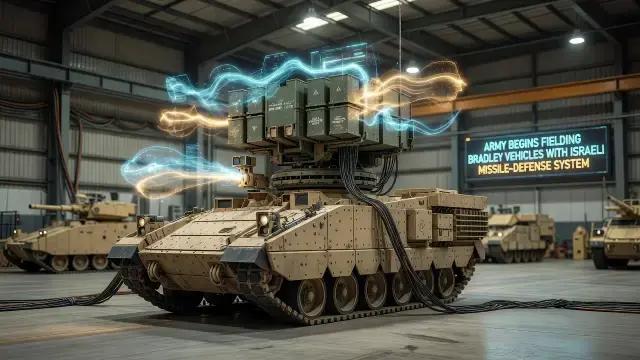
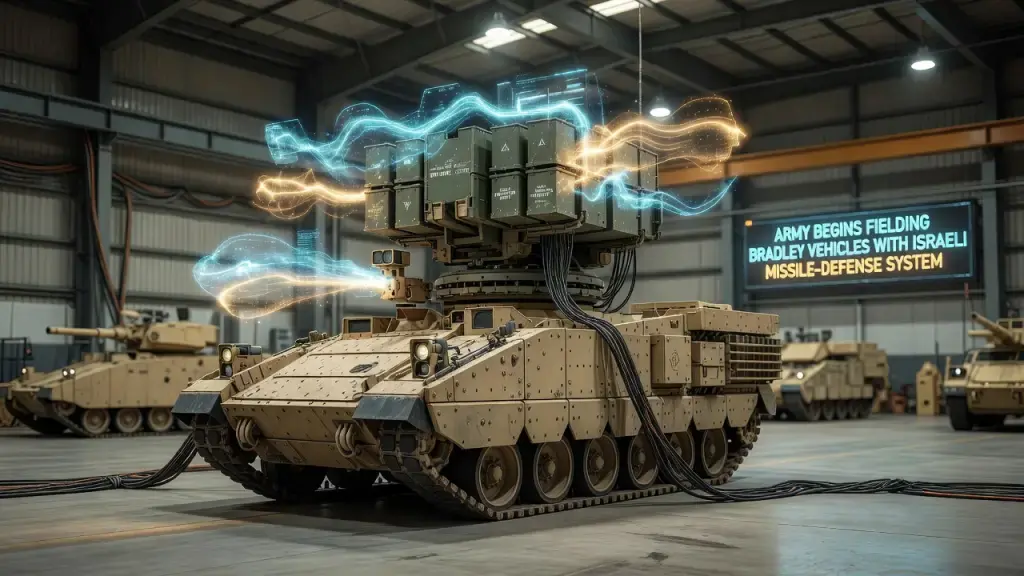
The U.S. Army has started equipping Bradley Fighting Vehicles with an active protection system built to shoot down incoming missiles, rockets and drones before they strike, marking a significant shift in how the service protects its armored crews. The 1st Cavalry Division's 6th Squadron, 9th Cavalry Regiment, based at Fort Hood, Texas, is the first unit receiving the upgraded M2A4E1 Bradley, which integrates Elbit Systems' Iron Fist system under a $228 million contract awarded in January.
The rollout comes as militaries worldwide reassess how exposed armored vehicles are to shoulder-fired missiles and cheap aerial drones, threats that have proven deadly in recent conflicts. Much like someone shielding their streaming habits with a VPN while watching HBO Max away from home, the logic behind Iron Fist is defensive layering: a vehicle, like a data connection, needs active countermeasures rather than passive armor alone to survive in a contested environment. The comparison is imperfect, but the underlying principle, anticipating an attack and neutralizing it before damage occurs, is the same. watching HBO Max away from home
How the Intercept System Works
Iron Fist relies on radar and infrared sensors mounted around the Bradley's turret to detect approaching threats, then fires explosive interceptors designed to destroy the weapon before it reaches the vehicle's hull. Engineers built the interceptor casings from combustible materials to limit fragmentation that could injure nearby infantry, though the Army and Elbit acknowledge this does not remove that risk entirely. The system represents a category known as active protection, distinct from the reactive armor and composite plating that have long been the standard for shielding crews.
This approach has gained urgency because modern anti-tank weapons and loitering munitions are inexpensive, widely available and have inflicted heavy losses on armored formations in recent fighting. Vehicles once considered survivable against older rocket-propelled grenades are now vulnerable to precision-guided munitions that can be launched from a distance, often by a single operator with minimal training.
Contract Scope and Unanswered Questions
Elbit's work on Iron Fist for the Bradley program began with a $37 million order in 2024, followed by the much larger $228 million contract finalized this past January. That agreement establishes a framework for installing the system more broadly across the Bradley fleet, though the Army has not specified how many vehicles will ultimately receive it or when a full rollout might conclude. General Dynamics remains the lead integrator for the Bradley upgrade program, with Elbit supplying the protection technology rather than overseeing the vehicle modernization effort overall.
Revenue from the contract will be recognized incrementally as systems are delivered and installed, according to Elbit, though exact timing has not been made public. Beyond Iron Fist, the M2A4E1 variant also includes an upgraded high-definition thermal sight for gunners and a redesigned environmental control unit intended to improve conditions for crew and passengers during extended operations.
What Comes Next
The pace and scale of fielding beyond Fort Hood remain undefined, leaving open questions about how quickly the wider Bradley fleet will receive the upgrade and how the Army will prioritize units for early delivery. What is clear is that active protection systems are moving from experimental status toward standard equipment, a shift driven largely by lessons from recent battlefields where armored vehicles without such defenses have suffered disproportionate losses.